Upper Gastrointestinal Bleed
Summary
Upper gastrointestinal bleed (UGIB) presents with haematemesis, melaena, or both. Common causes include peptic ulcer disease (most common), oesophageal varices, Mallory-Weiss tear, and malignancy. Risk stratification using Glasgow-Blatchford or Rockall scores guides management. Treatment involves resuscitation, IV PPI, and urgent endoscopy within 24 hours with appropriate intervention.
Key Facts
- Definition: Bleeding from a source proximal to ligament of Treitz
- Incidence: 50-150 per 100,000 per year
- Pathognomonic: Haematemesis and/or melaena
- Gold Standard Investigation: OGD within 24 hours
- First-line Treatment: Resuscitation + IV PPI + endoscopy
- Prognosis: Mortality 5-10%
Clinical Pearls
Transfusion Pearl: Restrictive transfusion (Hb target 70-80) improves outcomes.
Variceal Pearl: Terlipressin + antibiotics before endoscopy if varices suspected.
Blatchford Pearl: Score 0 = very low risk, may not need admission.
Glasgow-Blatchford Score
- Urea, Hb, systolic BP, pulse, melaena, syncope, liver disease, heart failure
- Score 0 = safe for outpatient management
Algorithm
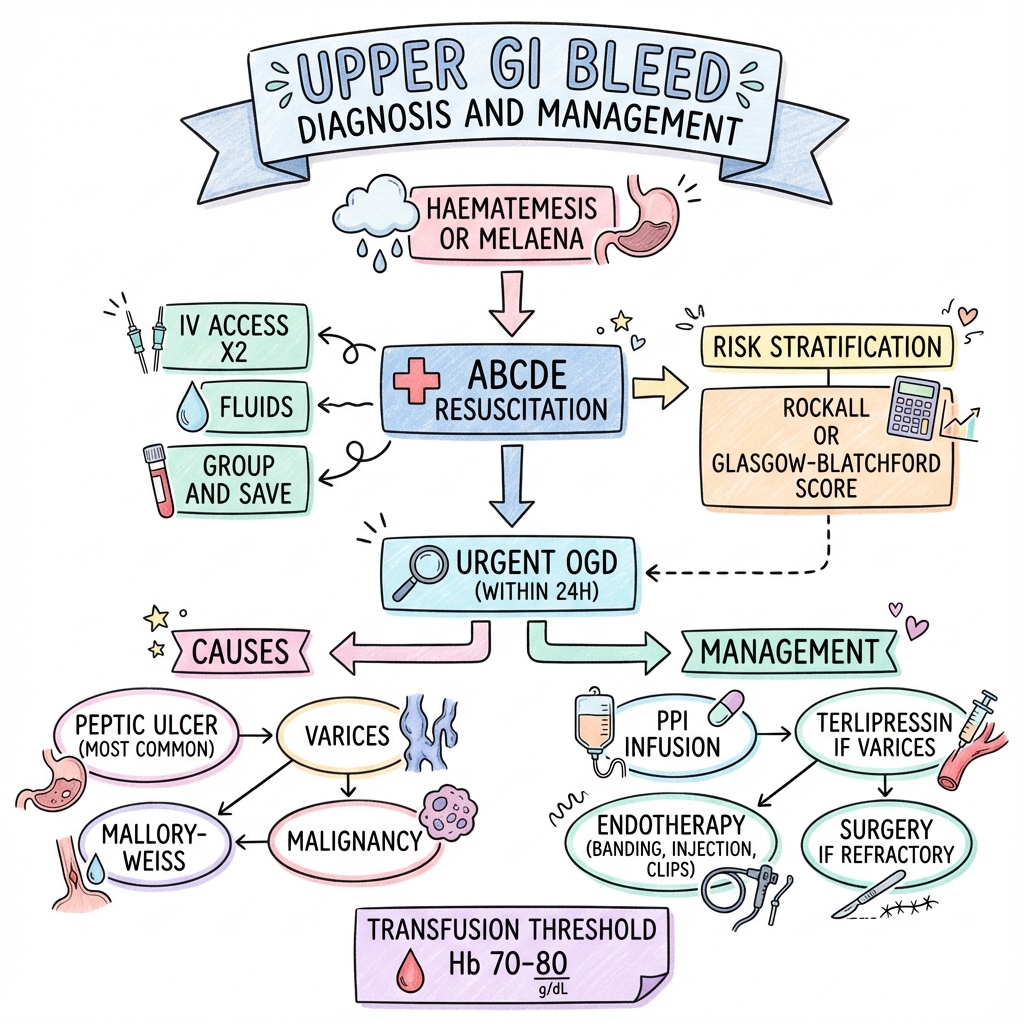
Initial
- ABCDE, 2 large-bore IV cannulae
- Group and save/crossmatch
- IV PPI (omeprazole 80mg bolus then 8mg/hr)
- Transfuse if Hb less than 70
Variceal
- Terlipressin 2mg IV bolus
- Antibiotics (ceftriaxone)
- Urgent endoscopy (banding)
Endoscopy
- Within 24h
- Immediate if haemodynamically unstable
-
NICE guideline CG141. Acute upper gastrointestinal bleeding. 2012 (updated 2016).
-
Barkun AN et al. International Consensus Recommendations on the Management of Upper UGIB. Ann Intern Med. 2019. PMID: 30802891
Viva Points
"UGIB: peptic ulcer most common cause. Blatchford score 0 = low risk. Restrictive transfusion (Hb 70). IV PPI. OGD within 24h. Terlipressin if varices."
Last Reviewed: 2026-01-01 | MedVellum Editorial Team