Thyroid Storm
Summary
Thyroid storm is a life-threatening exacerbation of thyrotoxicosis characterised by severe hyperthyroidism with systemic decompensation. It typically occurs in patients with underlying hyperthyroidism (often Graves' disease) after a precipitating event such as infection, surgery, or trauma. Clinical features include hyperpyrexia, severe tachycardia, altered mental status, and cardiovascular collapse. Diagnosis is clinical using the Burch-Wartofsky score. Treatment follows five pillars: blocking thyroid hormone synthesis, release, and peripheral conversion, plus beta-blockade and supportive care. Mortality remains 10-30% even with treatment.
Key Facts
- Definition: Life-threatening thyrotoxicosis with systemic decompensation
- Incidence: Rare; 1-2% of thyrotoxic patients
- Peak Demographics: Patients with uncontrolled hyperthyroidism + precipitant
- Pathognomonic: Burch-Wartofsky score greater than 45
- Gold Standard Investigation: Clinical diagnosis (labs not diagnostic)
- First-line Treatment: PTU + iodine + beta-blocker + steroids + supportive
- Prognosis: 10-30% mortality
Clinical Pearls
Emergency Pearl: PTU is preferred over carbimazole as it also blocks T4 to T3 conversion.
Sequence Pearl: Give antithyroid drugs BEFORE iodine (1-2 hours) - iodine can initially increase hormone release.
Supportive Pearl: Aggressive cooling and volume resuscitation are essential.
- Infection (most common)
- Surgery (especially thyroid)
- Trauma
- Radioactive iodine
- Iodinated contrast
- Drug withdrawal
- Pregnancy/delivery
- DKA
| System | Features |
|---|---|
| CNS | Agitation, delirium, seizures, coma |
| Cardiovascular | Tachycardia (greater than 140), AF, heart failure, shock |
| Thermoregulation | Hyperpyrexia (greater than 40°C) |
| GI | Nausea, vomiting, diarrhoea, jaundice |
Burch-Wartofsky Score
- Temperature, CNS, GI-hepatic, cardiovascular components
- Greater than 45 = highly suggestive of storm
- 25-44 = impending storm
- Less than 25 = unlikely
| Test | Finding |
|---|---|
| TSH | Suppressed |
| T3/T4 | Elevated (but may be similar to uncomplicated thyrotoxicosis) |
| LFTs | Often elevated |
| Glucose | Variable |
Algorithm
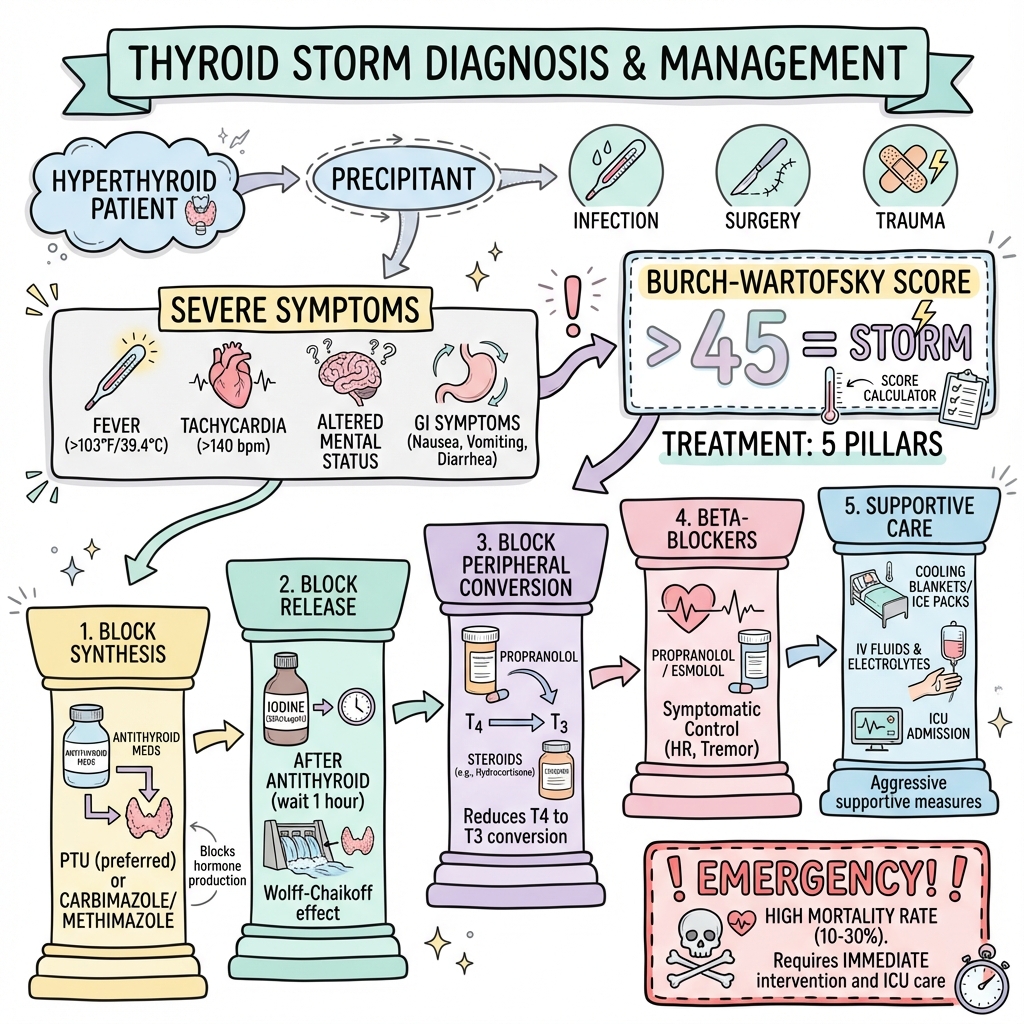
Five Pillars
| Pillar | Treatment |
|---|---|
| 1. Block synthesis | PTU 200mg q4h OR Carbimazole 20mg q4h |
| 2. Block release | Lugol's iodine 5 drops q6h (AFTER antithyroid) |
| 3. Block peripheral conversion | Propranolol + Hydrocortisone 100mg q8h |
| 4. Beta-blockade | Propranolol 60-80mg q4-6h (or IV esmolol) |
| 5. Supportive | ICU, cooling, fluids, treat precipitant |
Additional
- Cholestyramine (binds enterohepatic T4)
- Plasmapheresis if refractory
-
Burch HB, Wartofsky L. Life-threatening thyrotoxicosis. Thyroid storm. Endocrinol Metab Clin North Am. 1993;22(2):263-277. PMID: 8325286
-
Akamizu T et al. Diagnostic criteria, clinical features, and incidence of thyroid storm. Thyroid. 2012;22(7):661-679. PMID: 22690898
Viva Points
"Thyroid storm is life-threatening thyrotoxicosis. Burch-Wartofsky score greater than 45. Treat with 5 pillars: block synthesis (PTU), block release (iodine AFTER antithyroid), block conversion (propranolol, steroids), beta-blockade, supportive care."
Last Reviewed: 2026-01-01 | MedVellum Editorial Team