Hyperkalaemia
Summary
Hyperkalaemia is a potentially life-threatening electrolyte emergency. Severe hyperkalaemia (K+ greater than 6.5 or ECG changes) requires immediate treatment to prevent cardiac arrest. Management follows three steps: cardioprotection (calcium), shifting potassium intracellularly (insulin-glucose, salbutamol), and potassium elimination (dialysis, resins).
Key Facts
- Definition: Serum K+ greater than 5.5 mmol/L
- Pathognomonic: Peaked T waves, widened QRS on ECG
- Gold Standard Investigation: Serum K+, ECG
- First-line Treatment: Calcium gluconate for cardioprotection
- Prognosis: Good if treated promptly; fatal if missed
Clinical Pearls
ECG Pearl: Peaked T waves are earliest sign; sine wave is pre-arrest.
Calcium Pearl: Calcium stabilises the heart but doesn't lower K+ - treat the K+!
Insulin Pearl: Always give glucose with insulin to prevent hypoglycaemia.
- Peaked T waves
- Flattened P waves
- Prolonged PR interval
- Widened QRS
- Sine wave → VF/asystole
Algorithm
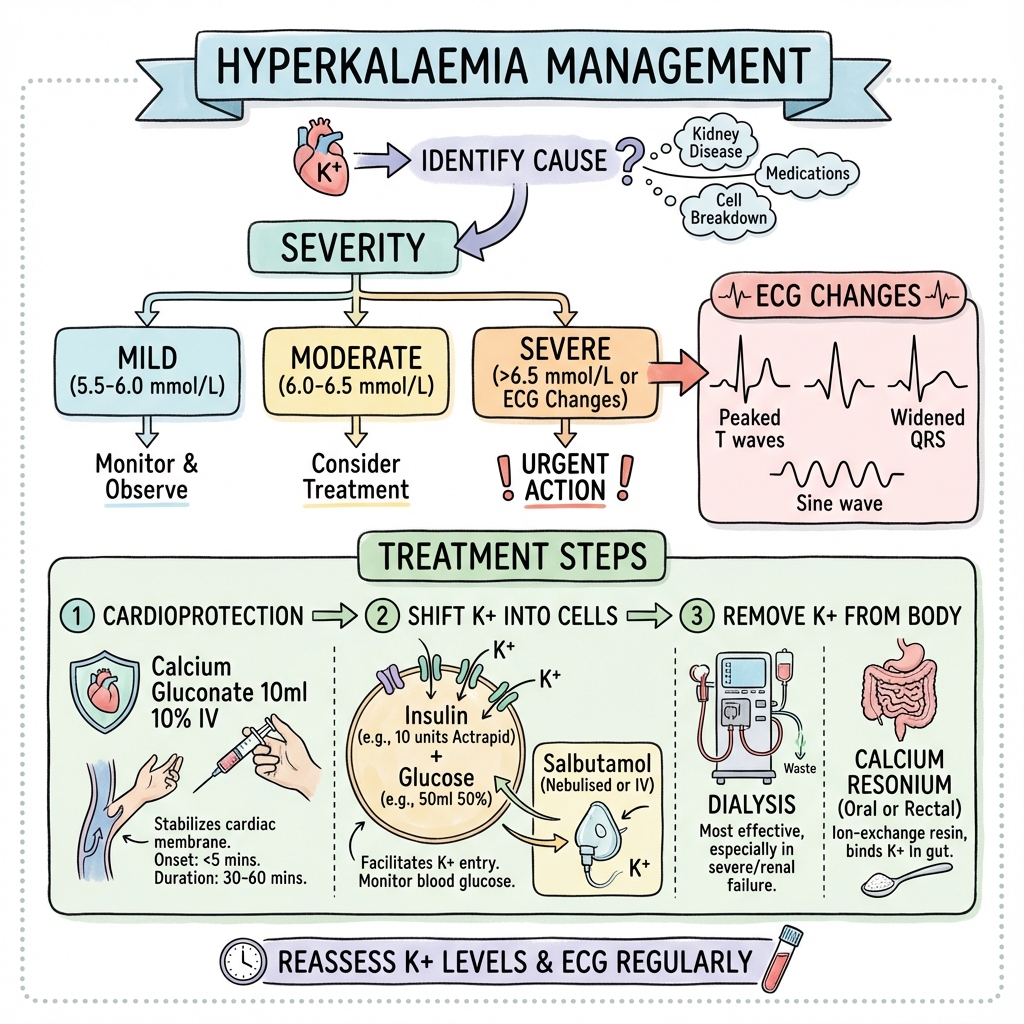
Treatment Steps
| Step | Intervention | Details |
|---|---|---|
| 1. Cardioprotection | Calcium gluconate | 10ml 10% IV over 2 min |
| 2. Shift K+ | Insulin + glucose | 10U Actrapid + 25g glucose |
| 2. Shift K+ | Salbutamol | 10-20mg nebulised |
| 3. Remove K+ | Dialysis | If severe/refractory |
| 3. Remove K+ | Calcium resonium | 15g QDS (slow) |
-
UK Renal Association. Hyperkalaemia Guidelines. 2020.
-
Kovesdy CP. Management of hyperkalaemia in chronic kidney disease. Nat Rev Nephrol. 2014;10(11):653-662. PMID: 25157840
Viva Points
"Hyperkalaemia emergency if K greater than 6.5 or ECG changes. 3 steps: 1. Calcium for heart, 2. Shift K (insulin-glucose, salbutamol), 3. Remove K (dialysis). ECG: peaked T → sine wave → arrest."
Last Reviewed: 2026-01-01 | MedVellum Editorial Team