Cryoglobulinaemic Vasculitis
Summary
Cryoglobulinaemic vasculitis is a small-vessel vasculitis caused by cryoglobulins - immunoglobulins that precipitate at cold temperatures and redissolve on warming. Type I cryoglobulinaemia is associated with haematological malignancies. Types II and III (mixed cryoglobulinaemia) are most commonly associated with hepatitis C infection. Clinical features include palpable purpura, peripheral neuropathy, arthralgia, and membranoproliferative glomerulonephritis. Treatment focuses on the underlying cause (HCV antivirals), with rituximab or plasma exchange for severe manifestations.
Key Facts
- Definition: Vasculitis caused by cold-precipitating immunoglobulins
- Incidence: Rare; associated with HCV in 70-90%
- Peak Demographics: Middle-aged adults
- Pathognomonic: Cryoglobulin positive + palpable purpura + low C4
- Gold Standard Investigation: Cryoglobulin assay (warm transport)
- First-line Treatment: Treat underlying cause; rituximab for severe
- Prognosis: Good if underlying cause treated
Clinical Pearls
Diagnostic Pearl: Sample must be transported at 37°C - cryoglobulins precipitate if cold.
HCV Pearl: Test all cryoglobulinaemia for HCV - it's the most common cause.
Complement Pearl: C4 is characteristically low (classical pathway activation).
| Type | Immunoglobulin | Association |
|---|---|---|
| I | Monoclonal IgM or IgG | Haematological malignancy |
| II | Monoclonal IgM + polyclonal IgG | HCV (most common), autoimmune |
| III | Polyclonal IgM + IgG | HCV, infections, autoimmune |
| System | Manifestation |
|---|---|
| Skin | Palpable purpura (lower limbs) |
| Joints | Arthralgia |
| Nervous | Peripheral neuropathy (sensorimotor) |
| Renal | MPGN |
| Hyperviscosity | Confusion, visual changes |
| Test | Finding |
|---|---|
| Cryoglobulin | Positive (warm transport!) |
| C4 | Low |
| Rheumatoid factor | Often positive (Type II) |
| HCV | Positive in majority |
Algorithm
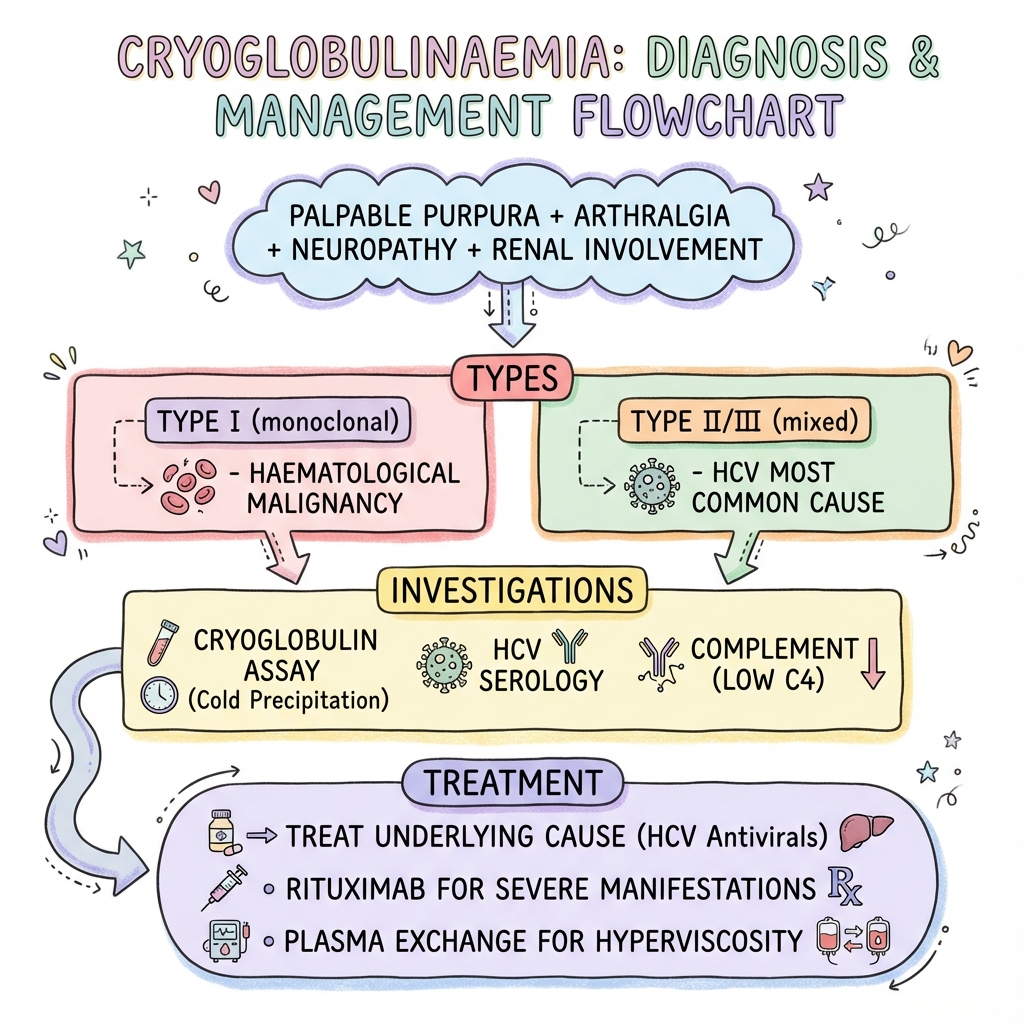
HCV-Related
| Treatment | Notes |
|---|---|
| DAA antivirals | First-line; cure HCV |
| Rituximab | Severe vasculitis |
Non-HCV (Haematological)
| Treatment | Notes |
|---|---|
| Treat underlying malignancy | |
| Plasma exchange | Hyperviscosity |
-
Cacoub P et al. Cryoglobulinemia Vasculitis. Am J Med. 2015;128(9):950-955. PMID: 25908393
-
Ferri C et al. Mixed cryoglobulinemia: demographic, clinical, and serologic features. Arthritis Rheum. 2004;51(2):317-326. PMID: 15077268
Viva Points
"Cryoglobulinaemia: cold-precipitating immunoglobulins. Type I = malignancy; Type II/III = HCV. Features: purpura, neuropathy, MPGN. Low C4. Treat HCV with antivirals; rituximab for severe vasculitis."
Last Reviewed: 2026-01-01 | MedVellum Editorial Team