Adult-Onset Still's Disease
Summary
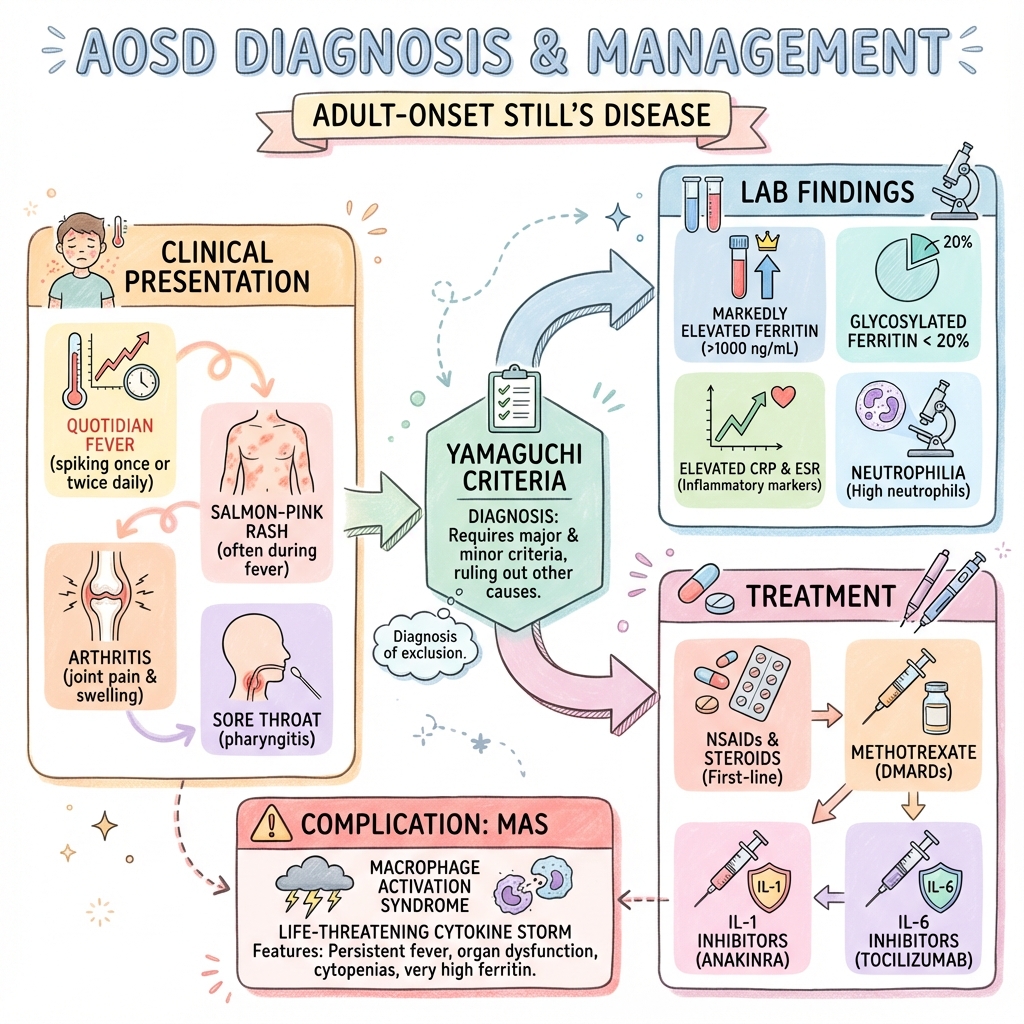
Adult-onset Still's disease (AOSD) is a rare systemic autoinflammatory disorder characterised by quotidian (once daily) spiking fevers, evanescent salmon-pink rash, arthritis, and marked systemic inflammation. It is a diagnosis of exclusion after ruling out infection, malignancy, and other autoimmune diseases. Laboratory findings include strikingly elevated ferritin with low glycosylated ferritin (less than 20%), and neutrophilic leucocytosis. Macrophage activation syndrome (MAS) is a life-threatening complication. Treatment has evolved from steroids and methotrexate to IL-1 and IL-6 inhibitors.
Key Facts
- Definition: Systemic autoinflammatory disorder (adult form of systemic JIA)
- Incidence: 0.2-0.5 per 100,000
- Peak Demographics: Young adults (16-35 years); bimodal
- Pathognomonic: Quotidian fever + rash + very high ferritin with low glycosylated ferritin
- Gold Standard Investigation: Yamaguchi criteria + exclusions
- First-line Treatment: NSAIDs/steroids; IL-1 or IL-6 inhibitors for refractory
- Prognosis: Variable; monocyclic, polycyclic, or chronic articular patterns
Clinical Pearls
Diagnostic Pearl: Glycosylated ferritin less than 20% is highly specific for AOSD (normally 50-80%).
Complication Pearl: MAS can develop - monitor for falling ferritin paradoxically, cytopenias, coagulopathy.
Treatment Pearl: Anakinra works rapidly in systemic symptoms; tocilizumab effective long-term.
| Feature | Frequency |
|---|---|
| Quotidian fever (greater than 39°C) | 95% |
| Arthritis/arthralgia | 90% |
| Salmon-pink macular rash | 85% |
| Sore throat | 70% |
| Lymphadenopathy | 60% |
| Hepatosplenomegaly | 50% |
| Serositis | 20% |
Yamaguchi Criteria
Major:
- Fever greater than 39°C lasting over 1 week
- Arthralgia/arthritis greater than 2 weeks
- Typical rash
- Leucocytosis (greater than 10,000 with greater than 80% granulocytes)
Minor:
- Sore throat
- Lymphadenopathy/splenomegaly
- LFT abnormalities
- Negative ANA/RF
| Test | Finding |
|---|---|
| Ferritin | Very elevated (often greater than 10,000) |
| Glycosylated ferritin | Less than 20% (specific) |
| CRP/ESR | Markedly elevated |
| WCC | Leucocytosis (neutrophilia) |
| LFTs | Elevated |
| ANA/RF | Negative |
Algorithm
First-Line
| Drug | Notes |
|---|---|
| NSAIDs | Mild cases |
| Steroids | Prednisolone 0.5-1mg/kg |
DMARDs
| Drug | Notes |
|---|---|
| Methotrexate | Steroid-sparing |
Biologics
| Drug | Notes |
|---|---|
| Anakinra | IL-1 inhibitor; rapid effect |
| Canakinumab | IL-1 longer-acting |
| Tocilizumab | IL-6 inhibitor; effective |
MAS Treatment
- High-dose steroids
- Cyclosporine
- Anakinra
-
Feist E et al. Mechanisms, biomarkers and targets for adult-onset Still's disease. Nat Rev Rheumatol. 2018;14(10):603-618. PMID: 30218025
-
Fautrel B et al. Proposal for a new set of classification criteria for adult-onset Still disease. Medicine. 2002;81(3):194-200. PMID: 11997716
Viva Points
"AOSD: quotidian fever, salmon-pink rash, arthritis, sore throat. Very high ferritin with low glycosylated ferritin. Yamaguchi criteria. Treat with steroids, then IL-1/IL-6 inhibitors. Watch for MAS."
Last Reviewed: 2026-01-01 | MedVellum Editorial Team